
Doug Conant is an internationally renowned business leader, bestselling author, and champion of leadership that works. Over a 40 year career, he led Nabisco Foods, transformed Campbell Soup Company into a top tier performer, and later served as Chairman of Avon Products. He is the founder of ConantLeadership and co-author of bestselling books rooted in his experience elevating employee engagement and building high-trust, high-performance cultures. Today, he continues advancing principled leadership through his Higher Ground initiative at ConantLeadership.
>> Craig Gould: Doug Conant, thank you so much for joining me today on the podcast. You’re one of the rare leaders who has not only led iconic global companies through moments of real adversity, but it’s also taken the time to study leadership as a craft. From Nabisco to your decade long transformation of Campbell Soup Company to your work with Avon, and now through comment Leadership, your career is consistently centered on building high trust, high performance organizations where people and results reinforce one another. For many leaders, your book the Blueprint became a practical guide for leading with clarity and humanity. And now as you prepare to introduce Higher Ground in this golden anniversary of your professional life, it feels like a continuation and evolution of that work, shaped by a world that’s more anxious, complex and more nonlinear than ever. Doug, before I get to all of that, which is a, deep well, I love to start these conversations with one common question, which is, Doug, what are your memories of your first job?
>> Doug Conant: Well, it’s funny, I’m literally, authoring an article right now, which will be published in the early summer, which is really going to be used to completely launch my, my new thinking around something I call the Higher Ground Leadership Success System. And I started out with my first week on my first job. So, it’s a funny story. I went straight through undergraduate to graduate school at Northwestern and then on to Kellogg. I’m so old, it wasn’t even called Kellogg then. It was called the Northwestern University Graduate School of Management Science. And I graduated from there, when I was 24 or 25. and the only reason I went to graduate school was because I didn’t know what else to do. And I was able to get it paid for by the athletic department because I was working as an assistant coach. And it just seemed to make sense at the time. And not knowing what to do, it was really the only practical alternative. I was then recruited to go work at General Mills in brand management. And a sidebar there. My professor, who was like a God in the marketing community, Phil Kotler, who basically wrote the book on marketing that every business school used, he figuratively sort of put his arm around me, much like the, movie the Graduate with Dustin Hoffman when he goes to a pool party. He’s graduated from school and he doesn’t know what he’s going to do. And one of his family friends, the father comes over and puts his arm around him and he says, I have one word for you. What’s that? Plastics. You want to get into plastics? It’s the next big thing. And Phil put his arm around me figuratively, and said, doug, I have two words for you. Brand management. That’s the next big thing. And so I interviewed for a brand management position. I was hired by General Mills, which was one of the three consumer products companies that was literally practicing it at the time. General Mills, General Foods, and Procter and Gamble. I went up there, didn’t know a soul. I showed up in a khaki suit. I’d been a tennis player. I showed up in a khaki suit with a yellow shirt, a big wide madras tie, brown earth shoes. And, I walk in and everybody’s wearing a dark blue suit with a white shirt, well groomed hair, red tie. And here I am with floppy tennis hair, a tan line from where my wore my headband, and I was a fish out of water. but, I persevered through all that. There are many stories related to it. But the first week I was there, I was lost. It was like a giant building. And I’m wandering around trying to find my way. And this elderly guy pulled me aside and said, first week, and said, son, you look lost. And I was. And I was lost in every sense of the word. I didn’t know anybody. I hadn’t even found an apartment yet. I was living in a motel, the Ambassador motel on Highway 12. And, son, you look lost. Let me help you. And he guided me to where I needed to go. And it turned out. How did I know that he was the CEO of General Mills? And he was just walking around the halls basically looking for lost sheep. And he found me and he guided me to where my office was. And, that’s what I remember from my first week on the job, that this kindly person with great humility and great kindness showed up and showed me the way. And I’m talking 50 years ago, and I remember as if it was yesterday. And in a way, that’s sort of the path I’ve chosen in my career, which is showing up and trying to help people find their way. I’ve been a student of the craft of leadership, and I’ve lived it every which way for 50 years. but it sort of all started the first week when I was lost in the halls of General Mills.
>> Craig Gould: There’s so much to unpack there. That’s. That’s great. You know, in terms of, you know, when you go to graduate school, the leadership part isn’t necessarily part of the curriculum. Right. You know, there’s all these numbers. How to pick, apart Strategy. But in terms of people and shepherding, that’s not exactly baked into, at least in that generation, that was a little too soft to be baked into the curriculum. But you know, the story that you tell about the CEO kind of finding you and shepherding you, it sounds like eventually that kind of became part of your practice. The walking, you know, the connecting with people. Can, can you talk about that sort of EQ part of being a hands on executive?
>> Doug Conant: I think the most important thing is that people show up and you know, Bill George had it right in a highly authentic way. And so they got to really be in touch with who they are and how they want to show up and you got to do work to do that. And we may get into that, but in my case it took me a long time, but I found my way to showing up as the person that I wanted to be. The best version of myself. And that does include showing up for people and helping them navigate challenging circumstances that turns out to be basically who I am. it’s a shame I’m slow. So it took me a long time to learn that. but once I started to hit stride with it, I’ve really grown into it the last 20 or 30 years. But you know, the first 20 I was trying to make everyone else happy and trying to be the hard nosed guy that found the busted number in the spreadsheet and could make the strategy better and could find a way to cut more cost faster, better, more completely than the other guy. very competitive. but I’ve sort of lived into this perspective that says all of that is important, but it’s insufficient. And I think great leaders need iq, EQ and something I call fq. And the EQ piece of this is not to be underestimated. I think it’s probably the most important piece right now. As anxiety goes up, in the culture, being able to help people manage through that anxiety becomes mission critical. I think it was always mission critical, but it’s more critical now than ever before. So, connecting with people. My philosophy is it’s all about people first. Leaders need followers. And so how do you get followers who are going to be supportive of your agenda in an enduring way? And my belief is the only way that’s going to happen in an enduring way is if you actually pay attention to their agenda. And in the fullness of time, the more you pay attention to their agenda, the more they pay attention to yours. It’s not rocket science. And I delight in paying attention to other people’s agenda and all the high impact leaders I know who are building enduring propositions, and I’ll talk use that word a lot because episodically you can leverage fear and intimidation and transactional behavior to get what you want. It’s hard to make that an enduring proposition because the moment you leave the room, there’s this reservoir of concern and ill will that will ultimately, in my opinion, be your undoing. So I focus on building world class relationships with world class talent that has the iq, the EQ and the FQ is your functional skills, to deliver extraordinary results. And it starts with connecting with people first.
>> Craig Gould: That’s really beautiful because, you know, my experience is that people want to be known, they want to be seen, they want to be heard. Right. And, so much of those barriers, kind of come up when people don’t feel like they’re being heard. If they don’t see that there’s an authentic interest on the part of the other person to know what they’re going through. And so to hear that reciprocity is so important in that relationship, it really seems to ring true with what I’ve encountered in trying to get people on board together. It goes back to this notion of trust. Right. I mean, people, aren’t going to impart their trust with you until you’ve earned it.
>> Doug Conant: Right? Yeah. Well, in our first book that I wrote with Mena Norgaard, called Touchpoints, was New York Times bestseller. We talked about leading by listening. You sort of have to declare where you’re coming from and you have to present a structured approach for moving things forward. But then you have to listen a lot so that you understand your audience and all the nuances of that audience so that you can effectively lead them. And if you’re doing it right, they’re also leading you. So, this leading by listening is a big deal. And it’s a bigger deal today than it was when I started. When I started in 1976 Dark Ages. You weren’t even born yet.
>> Craig Gould: I don’t think I was.
>> Doug Conant: Oh, oh, you’re older than you look.
>> Craig Gould: Well, I was in first grade, but yeah.
>> Doug Conant: Oh, okay. All right. Okay. Well, you were young. The corporate world and the world at large really drove off a militaristic hierarchical model of leadership. You do what I say you do. If I say jump, you don’t say why, you say how high? If you didn’t know what to do, you went and asked your boss, how do I do this today? That model is just flawed from the Beginning to the end. People need to feel heard before they’re going to listen to you. And you need to earn their trust before they’re going to even take, forget jumping. You’re going to, they’re going to. Before they’re going to take a step, you’re going to have, they’re going to have to trust that you’re leading them in an integrity laden way. The model today is all about leading by listening in a collaborative model. That is ultimately my language is helping take the individual, the team or the organization to higher ground. Doing a little bit better today than you did yesterday with this mindset that in the fullness of time we’re going to do something special here because we’re going to be getting better every day. How great is that? In essence, at the heart of it, that’s the mindset.
>> Craig Gould: I don’t know if I’ve spoken with a CEO that would have described himself as being shy and an introvert. Okay. And I’ve heard you describe yourself that way, even going back as far as that’s the reason you chose tennis, because you. There’s this whole notion of just kind of being by your homework.
>> Doug Conant: Good job, Craig.
>> Craig Gould: And so my question is, you have bound to have not been a stranger to anxiety. I really believe that we live in a world where the scales are unequally weighted towards the extrovert. How have you navigated that and what have you found that has worked for you? I know it’s bound to have been tough, to have been an introvert and be leading at the top of an organization.
>> Doug Conant: Well, I’ve discovered there are a lot of introverts that are leading organization because they’ve really spent. They’ve become very thoughtful about what they do and they have this inner sense of being well anchored in who they are, which in the fullness of time helps them lead an enterprise. In my case, I’ve taken the Myers Briggs test five times. I’ve been an introvert every time. And all of us introverts, at least in one of these tests, want to be an extrovert because we want to be like those people, you know. And I’ve had trouble with that. I had trouble with that my whole life. As a result, I found myself with my nose in books. When I needed quiet time. I was not going out, hanging out with the guys and I was gathering myself every day. I went home from work and I would sort of hunker down and settle into my apartment before I was married and then spend time with my wife and Children after I was married. But, being an introvert, I think, has been a blessing for me because I’ve really become a student of what I love doing, which is helping people move ahead. And, that has been a blessing. I would also say that Maya Angelou had it right, because she basically said courage is the single most important trait, because without courage, you can’t practice any other trait. Well, and over time, I have built my courage, muscle up, so that I would be more comfortable stepping into situations where I had to assert myself more openly. I remember I met with a friend of a woman who’s now a friend of mine, Deborah Benton. She wrote a book, and she. You’d like her. She’s married to a cowboy. You would like her. she’s in Colorado now, in the Colorado Mountains. She wrote a book called Lions don’t need to Roar. And, I spent some time with her, and she was coaching me early in my career, very early. And we got into this introvert thing. And she said, doug, I want you to. Whenever you meet with people, you’re probably standing five steps away from them because you’re not comfortable getting any closer. I said, you’re right. Yeah, I’m definitely not. Yeah, I keep my distance. It’s just sort of my default position, I guess. And she said, okay, for the next week, I want you to get one step closer. She just, one step for a week. I said, I’m not doing that. That’s weird. And she said, no, just try for a week and tell me what you think. And I said, I don’t know. The spatial thing is very real for me. Try it. So I tried, changed everything. All of a sudden, I was one step closer. The conversation was different. I was different. And these people didn’t bite. I was perfectly safe. And before I knew it, I got one step closer. And then I was shaking hands. And then I had my arm on somebody’s shoulder, and I found out, gosh, this is not so bad. That was a lesson I learned. And the other lesson I’ve learned is that the more comfortable I am with how I want to approach my work, the more I have the courage of my convictions. And so I can show up that way because I’ve really worked it. most of the leaders we develop and help develop, through our blueprint work based on our second book and our program, they have trouble leading with conviction because they don’t know what their convictions are. They haven’t really cultivated those yet. They’re just reacting to all this stuff. That’s coming at them and doing the best they can with good intentions, but, they’re leading by the seat of their pants. Not good enough. We believe you need to have real conviction with how you lead. Which as an introvert, I sort of developed that so that between the Deborah Benton experience and all of my work trying to figure out what are my convictions, all of a sudden I was able to show up in a different way. And as a president, as a, CEO, as a leader, but it took work. I guess the last thought on this, and I’m full of thoughts, is that, leadership drives off a mastery model. You apprentice at it, and in the fullness of time, you begin to learn how to master elements of it. You never master it all, but, you work at it, and the more things you experience and the more things you do, you get better at it. I talked to the MBAs, and they’re, you know, they’ve worked for what, five to seven years. They’ve gone back, gotten their MBA, and, I’m talking to a class or something, and they’re basically saying to me, well, yeah, but, you know, your model is from yesterday, we’re talking today. And I say to them, well, how much have you learned in the last 10 years? A lot. Okay. Multiply that times five, and you’ll have the experience I have. There’s a lot more to learn, and never stop learning, never stop growing. But, there is wisdom in leading people and influencing change that you can cultivate over the years. And there’s no other way to learn it, in my opinion, doesn’t come from a book, it doesn’t come from a podcast. As good as this podcast is, it comes from lived experience married to the study of what you’re trying to accomplish.
>> Craig Gould: As I was listening to you talk about introversion versus extroversion, made me wonder, like, is there something that could be learned from you having been an introvert? Because, I mean, you chose, for whatever reason, which probably had to do with family, to have a two and a half hour commute each way at the end of the day. Right. And that was. There was sort of a, boundary that you set, but it also allowed you quiet and the ability to famously write these 30,000 notes that were, in a way, a far more intimate way of connecting with someone than even coming and putting your arm around them.
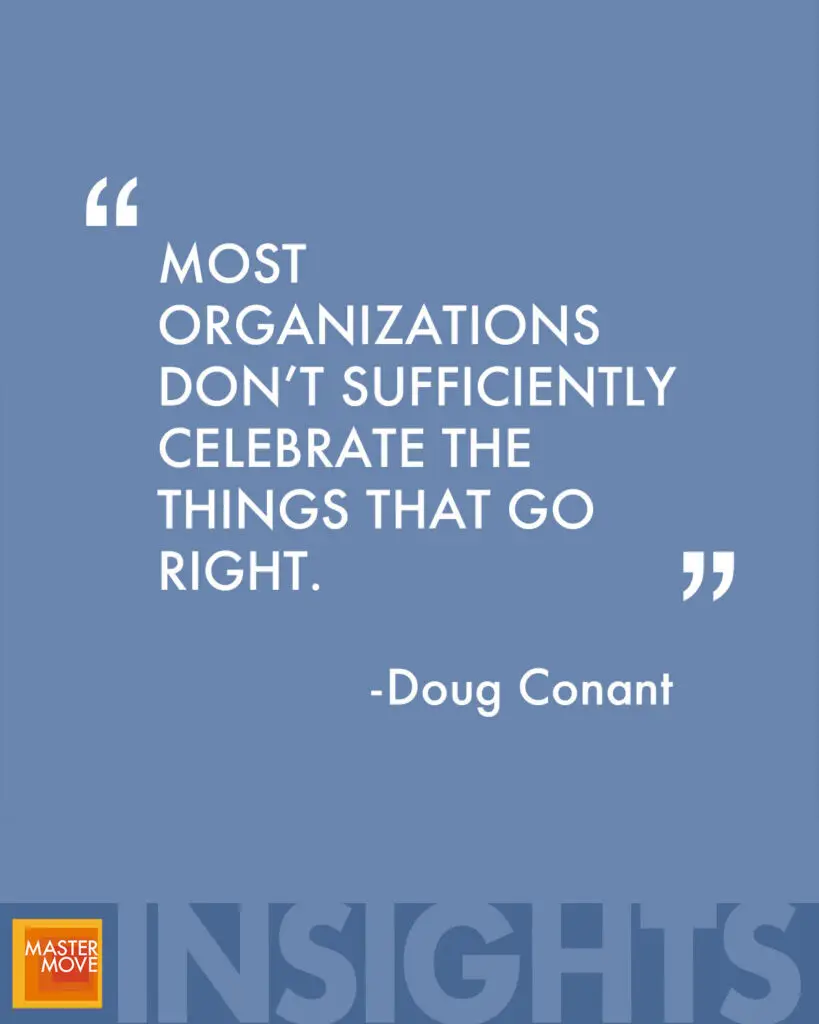
>> Doug Conant: Yeah, first of all, I did have a two and a half hour commute, from my home in New Jersey down to Philadelphia or Camden, New Jersey, where Campbell Soup was But at that point, two of my kids were out of school or out of high school and off at college. And my daughter was going to be a freshman in high school and we just weren’t going to move her. You know, we just made all the moves. We weren’t moving. We actually lived, maybe five minutes from my mother in law and ten minutes from my sister in law. And so we went into this with our eyes open and said we were going to, I would be doing the commuting for a while. Ultimately, when my daughter went off to college, we actually bought a place in Philadelphia which was 20 minutes from the office. And we spent a lot of time down there too. Although we maintained our home in New Jersey near my mother in law and sister in law. So, family mattered and we were always close to the schools and their events and everything else. So that was important. The commute. I think if you really want to lead effectively, you got to figure out how you want to show up for people. And then you got to find ways to bring that to life that are practical. Because I teach a lot of people and they have these grand plans for how they’re going to change their lives. And I don’t know which I think it was. Eisenhower said, I could be wrong with the, I’m not wrong with the concept. he valued a good plan well executed as opposed to a great plan poorly executed. Every time we have these grand designs for how we’re going to change our lives and then we can’t sustain them. So I encourage people to figure out how they want to walk in the world and then find ways to bring that to life with people. I had all that time in the car. I could make use of it. So when I went home every day, I’m old. So we had one portal at Campbell. My assistant would print everything off that portal for me to read in the car. I didn’t have technology in the car, until near the end of my tenure. So I’d have a pile of paper, I’d read all this stuff, these amazing things going on in the company, and I’d pull out 10 to 20 of them that really were pretty cool, where people were advancing the agenda of the company in a very inspiring way. And then on the way into work, I’d hand write a note to those 10 to 20 people every day. I did it six days a week because I also did it on Saturday and I took the Friday and Saturday stuff in same time. And it wasn’t saying Happy birthday, or I hope you had a nice day. It was, thanks for delivering the quarter in a quality way, or thanks for, some inspiring work on the third shift at the Arnott’s plant in Sydney, Australia. You made a difference today. There’s a story here that’s really inspiring. And, So I would 10 to 20 of those notes a day. And it did a couple things. One, it reinforced corporate strategy, which was important. Two, it told everybody I was paying attention, including the bosses of all these people who said, you’re writing notes to all my people. Should I be writing notes? I said, no, but, you should be celebrating contributions of significance. My observation, as an aside, is that all. Most large companies, large organizations get very good at critical thinking. We can find what’s wrong, and then we’re gonna go fix it. I can find a busted number in a spreadsheet. This doesn’t make sense. And then we go fix it. most organizations don’t sufficiently celebrate the things that go right. And I’ve been in two wildly broken companies. And 70 to 80% of the stuff was being done right, but nobody was talking about it. So I focused on the things that were being done right, that were being. That were aligned with our corporate direction and our values. And before I knew it, when I retired, Forbes was doing an interview and they said, we heard you’re a note guy. Did you do write notes? I said, I write them every day on the way into work. It puts a spring in my step. By the time I come into work, I’ve written 10 to 20 notes of people doing amazing things. I’m ready to go do amazing things too. And they said, well, how many of these have you written? I don’t know. I do 10 to 20 a day. So we did the math on 10 a day. Just 10, 6, days a week. and, we came up with 30,000 notes, which was low. And we only had 24,000 employees around the world. We were in 38 countries. but everybody everywhere, they had one of these small handwritten notes, hand signed by me, stuck in their cubicle, celebrating some contribution of significance. People need to know you’re paying attention. When Gallup does their employee engagement work, they have the world famous Q12 survey, which I heavily employed when I was working, ah, at Campbell. One of the 12 questions is, I’ve had praise from my manager in the last seven days, assuming you did something right in a week. And, you don’t have to do a lot, just something. And, they found that, that was mission critical to creating a high engagement culture. Basically I was doing that for employees all around the world and setting the tone for that with all the managers. Well, if the CEO’s paying attention to my folks, I better be paying more attention too. And you know, we gotta fix what’s wrong. That’s part of our job. But the other part of our job is celebrating what’s right.
>> Craig Gould: It sounds like that all of that positivity, all that praise provided you the equity to then be critical because they would know that it wasn’t just a one way street. It bought you the ability to be heard because you’ve established that you’re willing to see the positives and the negatives, right?
>> Doug Conant: Yeah, absolutely. Stephen Covey, one of my mentors. Stephen talked frequently about the emotional bank account and he basically said, look, if you’re leading people, you always want to be in the black because someday you’re going to have to make some giant withdrawal and you don’t want to go into the red because you could lose them. So you build the balance up. So, so it is an unassailable balance. So that when you do have to make those tough decisions, people are going to give you the benefit of the doubt, which they should. And so, man, we had to make a lot of tough decisions. We turned over 300 of our top 350 leaders in our first three years at Campbell, which I’ve never heard of in a large company before. That’s six out of seven. Now we promoted half of those 300 that left. We promoted people from within, so we created opportunities for them. The other half we hired from outside. And you know, and I’d never been a CEO before, I didn’t know my ass from my elbow. but I was, I was practicing, I was celebrating what was working. And I was thinking, well, I’m going to go down in flames here as we make these changes, but I don’t know any other way to do it. We’ve got to get a coach over here that’s appropriately balanced between what’s working and what’s not working. And, we don’t have the right team in place, but we’ve got to give them time and room. And over those three years, we made some tough decisions. But employee engagement went up every year because all those employees trusted us and they knew that we had to make those changes. You know, the managers would put on one face with us and then another face with the people that worked for them. And it wasn’t the same face. And so we had to get to the bottom of it. And that’s hard. That’s hard as a leader to be. How do you show up and be so damn positive while you’re making all these tough calls and these tough changes? it’s very difficult, but it’s really the only way to run a railroad if you want it to be an enduring win.
>> Craig Gould: Sure. along those lines, I’ve heard you say that in that period you really sort of saw yourself as the chief talent officer and that you absolutely, that you had intentionally gone out and had someone help you find the best people at all the different tasks and responsibilities. Just not necessarily to say, you know, here’s a job, I’m hiring for something specific. But it’s like you wanted to set a bar in your mind as to how the person in this role at the very highest level, how’s that person thinking? And if, if nothing else, you’ve, you’ve not only established that bar in your head, but you’ve also established a relationship with that person in case something did come up. Can you talk about what you learned through that process?
>> Doug Conant: Well, first of all, I really started it. I mean, I had, we had to start it. I, I, before I went to Campbell, I was at Nabisco and I joined Nabisco right after this episode called Barbarians at the Gate, where it became the world’s largest lbo. And there was a lot of management turnover. we had to recruit a lot of talent in because a lot of talent left. so I sort of had that experience at Nabisco. I brought it with me to Campbell. And I think if you believe in a people first mentality to all you do, you want to have the right people in place. As Jim Collins said, you know, what’s the first thing you do? You get the right people on the bus and then you figure it out in, good to great. And I needed to know what the right people looked like. I couldn’t just go into a company and bring all these people that I used to work with. I didn’t even know if they were the right people. I committed to this sort of talent is job one philosophy. And it’s about attracting, developing, engaging, leveraging, and retaining talent. It’s the full monty of talent development, attracting all the way to retaining. And, I wanted to know what world class looked like. So we basically had someone on the outside who I knew work with us. And I wanted to get to know two people a month, when I traveled, if I was going to Be in Los Angeles or New York for something. Is there somebody I could have coffee with? that’s regarded as world class in whatever field? if they’re in a CIO or a marketing person or a salesperson or a general manager who’s an up and comer. I just want to know best of class, any field. And I want to meet them and I want to have coffee with them today. There wasn’t a Zoom then. I probably would have done more. I would have had more Zoom calls. But, I just wanted to hear their story and learn about them and see what. Oh, so that’s what world class looks like. Okay, so I was basically seeing 25 people a year, 24. 25 people a year.
>> Craig Gould: For.
>> Doug Conant: I’m, oversimplifying. For a decade at Nabisco and a decade at Campbell for 20 years, 25 people a year. Now, it’s not that linear, but I saw a lot of really talented people. So I started to get a perspective on, oh, so that’s what a superior marketer looks like in the technology space. How could I leverage it in consumer packaged goods? Oh, that’s what a world class strategic thinker looks like from consulting. How could I leverage that within the context of Nabisco or Campbell Soup Company? As I looked at the larger playing field, I developed a point of view that was anchored in experience. That really, I didn’t think any other president or CEO had. They were so busy managing their little fiefdoms, they didn’t have their head up. They had their head on the ground looking at their company. That was important too. But I found if I had my head up some of the time, I had a better understanding of talent. I could attract people and I could retain them better than other guys. And that’s what led to, you know, 52 of them are now CEOs. And I couldn’t have done that if I wasn’t sort of scouting it myself. In addition to having a world class HR person working with me and other people. It wasn’t just me, but I, needed. I felt you got to pick your. Where you’re going to spend your time. What matters most. Stephen Covey had this great line. What matters most must never be at the mercy of what matters least. So you really had to think of, well, what matters most. Well, talent matters. And it’s more than just competence. It’s also character. And then you’ve got competence, character. And the third thing I would always look for was chemistry. How do they play well with others because they’ve got to fit into the chemistry that we’re creating in this environment. So, man, I spent a lot of time on it, but, nobody knew the talent like I knew talent. Nobody. We would do some talent searches and we’d have one of the talent, headhunter firms come in. Spencer, Stewart, Heydrich, Egon Zender. And I knew. They must have been shocked at how much I knew about the talent pool in the consumer packaged goods arena. They must have been shocked. and I’d met him, I was on a first name basis, and that was part of what I felt was my secret sauce when I was leading.
>> Craig Gould: You talk a lot about, being self aware, understanding who you are, understanding how not everybody’s blueprint is going to fit yourself. And I’m a huge believer in that because I’m a huge fan of strengths finders and knowing that because, you know, when I was younger, I was all about trying to shore up my deficiencies. And now I can see that I spent a lot of time, a lot of wasted time trying to, you know, plug holes in a boat that, you know, it would have been better if I had just been building a bigger sail. Right. And so I’m just wondering, did you find that, you know, when you were talking to all of these best of the best in, in their corners of, of, the professional world, were these people self aware of what they did best in and concentrated there? Had they, had they, you know, in whatever way kind of put that into practice?
>> Doug Conant: Well, sort of. But they were very human. I mean, we’re all very human. And you know, I can look back now and say things that are clearly obvious to me now, but when I was in the thick of thin things 20 years ago, I was just like everybody else, trying to find my way. And a lot of these leaders were like that too. What I could say is they really had figured out, what their key strengths were and they had leveraged them. And for the most part they knew what their weaknesses were and they had developed systems that complemented their approach and protected their blind side. So in general that was true, but not always. some of the most skilled people I met had some amazing blind spots, you know, but they had some amazing skills too, that sort of carried the day. Look, we all have these life experiences that are awfully instructive to how we want to, how we’re going to ultimately choose to walk in the world. But in my experience, most people like you and me, we sort of put those experiences in the parking lot and we worry about what’s next? And the next performance review. And these are the things you gotta work on. But, most people know how they wanna walk in the world. It’s in that parking lot already. They just haven’t spent any time there. They’re so busy looking forward and trying to figure out how am I gonna make this boss happy or how am I? But it’s all in the parking lot. And what we try and do with my work is we drag them into the parking lot for two days and say, okay, we’re going to roll around in this parking lot. And the answer is in here. The answer is in here. You are enough right now. We’re going to figure out what that looks like by going into your life. And you’re going to find some nuggets here that, that are gonna be highly instructive on how you move forward and what your strengths are and how you really wanna walk in the world so that you can be the best version of yourself. And when you get into that conversation, you do end up focusing on strengths and what your predilection is. And, interestingly, not surprisingly, that’s where you’re most fulfilled. You know, I love doing this stuff. I love talking to people and exercising my curiosity around leadership. Why don’t I do a podcast? Why don’t I talk about moving forward? you know, this speaks to me, right? So strengths ultimately become the answer. And leveraging your strengths, but also smartly manage, acknowledging and managing around your shortcomings. you got to do both if you want to be highly effective in the world.
>> Craig Gould: So tell me about Higher Ground. You know, we’re 50 years into our executive journey. We get to kind of commemorate it with this. What can you tell me about Higher Ground?
>> Doug Conant: Well, the concept here is in the blueprint. All my earlier work was all built around a spirit of continuous improvement, really. the last step in the blueprint, when we take people through the exploration of how they want to show up, the last question we ask is, how can I do better tomorrow than I did today? It’s doing better. It builds very much off Carol Dweck’s work at Stanford, which was all around a growth mindset, which, in a sentence, she did it. She studied it forever. But in one sentence, to me, it says, if you think you can do better, you probably will. If you think you can grow, you probably will. So we try and instill in people this growth mindset, and it never stops. Never stops. Stephen Covey, in his last book with his daughter Cynthia, living life in Crescendo he always believed that the next piece was the most important piece. And that’s the mindset on how you get to higher ground. It’s all about being tough minded on standards of performance and tenderhearted with people. Not one or the other. Both. It very much builds on Jim Collins language around embracing the genius of the and, and rejecting the tyranny of the. Or do you want to be tough minded on, performance or do you want to be tender hearted with people? The answer is both. The answer and you don’t have a choice. You’ve got to do both if you want them to follow you. It also is about pursuing, high performance and insisting that the results are high integrity. No give up, can’t give up. The third element of this is it’s about thinking, about what’s best for all the stakeholders in the value creation chain, not just in your company or your team, everybody thinking in terms of what’s a win for them in the short term and the long term. I mean, this is a high bar. High bar, right. And the last piece is it’s okay now, how can I bring that to life today and tomorrow in a more impactful way, in a growth mindset kind of way? So this pursuit of higher ground is a system we designed that built on all the blueprint work we did, which said, okay, you got to figure out what the best version of yourself is. And we’ve done that with thousands of people now. but then we say, oh, they do that. And then they have trouble translating that when they go back to work. I understand how I got to be better, but how do I bring that to life when I’m back in the trenches, you know, but how do I do that on Monday morning? And so what we designed was, we took my experience and we built a model called the Higher Ground Leadership model. And we said, you know, you gotta build the strongest imaginable foundation. And there are five levels to it, but it’s about having depth of character. And as you develop greater depth of character in an ever changing world, you’re going to have more courage to engage in that world. And then there are five things you have to do to get to higher ground and to actually make things happen. So There are like 10 steps, but it’s all around depth and reach. And, if you do it the way I’ve practiced it now for a long time, earnestly, for the better part of 30 years, you will find that you can get to higher ground and you can do it in an enduring way that is actually fulfilling. You’ll be glad you did it. it’s not perfect. Life is hard. But this is very doable. What I love about the model is it’s practical as well as compelling, simple. So, it’s got, you know, basically it says the first thing you do is build your foundation, then you honor all people, then you build trust, then you build a growth mindset. We talk about how to do this and then you make sure that all of that character work is anchored with, a higher purpose that transcends the ordinary because your life is special and you should be doing something special with it. Those five things help you create depth of character. And then there are five things about, okay, now I know what I want to do and how I want to do it. I’ve got to create a plan. I’ve got to make sure my resources are properly aligned and that’s people, time and money. Then I’ve got to make sure the team is highly motivated. Then we got to execute it well, and now we’re going to deliver. And when we deliver, it’s going to get easier to make this flywheel work next time. That, in a nutshell, is the higher ground leadership success model, and it’s a winner. It won for me in incredibly difficult circumstances. Took time, but we created some enduring success that leaders have taken with them to other companies and, and experience similar success. So that’s my story and I’m sticking to it.
>> Craig Gould: Well, I mean, it just seems like you mentioned earlier about how, you know, technology is changing, AI is changing, the way people do their jobs, you know, the, even just the workplace and distributed workforces. And it just seems like a huge part of your success and a huge part of, of the higher ground is maintaining, the humanity in leadership and maintaining humanity in an organization.
>> Doug Conant: Well, I think that’s part of it. But, you know, you can’t change all the stuff that’s changing around you. It’s only going to get. The tsunami is going to get bigger and be moving faster. I mean, we’re not naive, we know that. But what you can change is how you engage in it. And this is an inside out, process. This is really getting well anchored in how you want to show up and then doing that in a highly effective way with others. The more you’re well anchored in how you want to approach things, the more effective you’ll be. And most people aren’t. You know, you don’t have to be great at this because most people are not good at it. They’re floundering. You know, this is Conant’s theory of relativity. You don’t have to be brilliant at this. You just have to be better than the other guy. And by the way, the other guy is struggling just like you are. And so you got to get incredibly well anchored in how you want to show up in a compelling way for others. And then you got to show up that way with consistency. And you can do it. you know, you definitely can do it. So I got two little things I want to add to this that have really risen to the fore in the last few years that I’m really championing now. And the two values that I’m really pushing to the forefront are kindness and creativity. as the world becomes less friendly, you need to become more kindly. And people will come. Just like if you build it, they will come. If you manifest kindness, it will attract followers. It’s got to be done thoughtfully and carefully and wisely. But, as anxiety goes up, there is a premium placed on making sure that you’re manifesting a tender hearted care for others while you pursue high performance. Not either or both. But, kindness is essential. The other thing that’s essential is creativity because the problems we’re encountering now are wildly complicated. And, when we talk about AI that’s complicated, I can boil it down, but we’re not going to run out of time. But, we’ve got to embrace creative problem solving in a way that we didn’t have to before, because it used to be if this is the problem, this is what you do. That’s how I started my career. Now it’s just too complicated. So you’ve got to really be a creative problem solver. And that’s why I love your perspective about the importance of curiosity. You got to say, well, how is this working? How can we think about this differently? So creative problem solving and kindness are rising in terms of how important they are for people today, for leaders today. And, you gotta be comfortable embracing that. Or, you know, as I said, life is very Darwinian. You’re either gonna grow into your ability to lead this or you’re gonna fail.
>> Craig Gould: Well, Doug, I can’t thank you enough. This conversation has been tremendous. If we wanted to point people to higher ground, where can people find out more about Conant leadership?
>> Doug Conant: Well, what I’ve shared with you is yet to be published. It’s in peer review right now. So, you’re the first on your block to hear this. They should go to our website@conantleadership.com and on March 15, my golden anniversary, we’re going to start talking about this in a more complete way. But you’re the first on your block to hear about it. I would encourage people to go to konaleadership.com and, the important thing about I’ve been doing this a long time. This builds on all my prior work. And so this is very consistent with the work I’ve done. But it takes it all the way to bright. If you follow this model, and you will win, and you will do it in a fulfilling way, and you can do it. So that’s it.
>> Craig Gould: Well, Doug, again, I can’t thank you enough for your time. this has been, an amazing conversation, and I really appreciate you being willing to join me today.
>> Doug Conant: Okay. I’m happy to help.